Circular knitting machines, round looms and punch-card flatbeds all do the same trick: they make knitted fabric far faster than hands can, and they make it in one shape. Everything interesting happens in the two decisions either side of that — working out what size to knit, and turning the finished piece into an object. This is the reference for both, plus every calculator on this site that touches a machine or a loom. All of it is free and runs in your browser.
The tools
Eight of them. Nothing to sign up for, nothing to install.
The reference charts
The numbers you need before you start cranking. All printable.
Where to start, depending on what you have
A Sentro, addi or Jamit circular machine. Read the needle chart first — it tells you the one thing you cannot change, which is how big your tube is. Then use the round loom hat calculator for hats or the shaping calculator for anything else, and the Sentro pattern generator when you want stripes or colourwork.
A round loom. The peg chart maps every standard loom onto the heads it fits. The round loom calculator does one hat exactly, and the loom pattern generator writes out the rows.
A flatbed punch-card machine — Brother, Silver Reed, Toyota, Singer. That is a different machine from a Sentro: it uses 24-stitch punch cards, and it can shape. The punch card generator designs a card and prints it at true scale; the card library has ready-made ones.
A hook and no machine at all. The hat size chart and the crochet mode of the round loom hat calculator are for you — the crown-diameter maths is the part crocheters most often get wrong.
How to close the top of a machine-knit hat by hand
Every machine-knit hat needs this, because no circular machine can decrease. It takes about two minutes.
A Sentro, addi or Jamit knits a plain tube. There is no mechanism for moving a stitch from one needle to another, so there is no way to make the tube narrower at the top — which is what a crown is. The crown is therefore made by gathering: you run a strand of yarn through every live stitch of the last row and pull it into a circle small enough to disappear. Done properly it is invisible. Done badly it leaves a hole and a lump, which is the difference between a hat that looks homemade and one that looks made.
Knit a few rows of waste yarn before you take it off
When you have cranked your last real row, do not cast off. Join a contrasting scrap yarn and crank six to eight more rows, then take the tube off the machine. Those waste rows hold every live stitch open and stop the fabric unravelling while you work.
Leave a tail of your real yarn about three times the tube circumference — for an 18.5 inch tube, about 55 inches. Too short is the single most common mistake here.
Thread the tail and pick up every stitch
Put the tail on a blunt yarn needle. Working along the last row of real yarn, pass the needle through each loop in turn, all the way round, in order. Do not skip any, and do not go through the waste yarn. Keep the loops on the tail as you go.
Working from the inside of the tube is easier: you can see the row clearly and the tail ends up where you want it.
Pull out the waste yarn
Once every stitch is on the tail, unpick the scrap rows. They come away in a few tugs. Now the top of the tube is a ring of live stitches held on your yarn, and nothing can run.
Draw it closed, slowly
Pull the tail steadily until the ring closes. Do not yank — pull a few inches, ease the gathers even around the circle with a fingertip, pull again. Even gathering is what makes a flat crown instead of a puckered one.
Close it until the hole is gone. On a doubled hat the second layer hides it anyway, but on a single layer it has to be properly shut.
Secure it from the inside
Take the needle down through the centre of the gather to the inside of the hat. Make two or three small backstitches through the gathered stitches, catching a different stitch each time, then weave the tail through four or five inches of fabric and snip. A knot alone will work loose; the backstitches are what hold.
Fold, and do the second end
For the usual double-layer beanie, push one half of the tube inside the other so the gathered crown you just made ends up in the middle. Gather the second end the same way and tuck it against the first — the two crowns sit inside each other and neither shows.
For a single-layer hat, hem the brim instead: fold about an inch to the inside and slip stitch it down, or work a round of single crochet straight into the edge. Machine stockinette will curl if you leave it raw.
What to do if you want a real crown
A gathered crown is flat and slightly puckered at the very top — fine under a pom pom, obvious without one. If you want the shaped, spiralled crown you see on a hand-made hat, the honest answer is that the machine cannot give you one and you have to work it by hand: pick up the live stitches with a hook or needles instead of gathering them, and decrease down over six or eight rounds. That is exactly the top section of any top-down hat pattern, worked in reverse from your machine edge. It adds about twenty minutes and it is the difference people notice.
Turning a machine-knit tube into eight finished objects
Same tube, eight things. The row counts assume worsted at 7 rows per inch.
Beanie
The default. A tube twice the hat height, folded inside itself and gathered at both ends.
48 needles, worsted, 120 rows for an adult. Close the crown by hand — see below.
 Meadow Beanie
Cowl
A short wide tube, hemmed at both ends or folded double for warmth.
48 needles, 70 rows single layer for 10 inches, or 140 doubled. Hem the edges or it curls.
 Meadow Cowl
Leg warmers
Two tubes, hemmed at the top and bottom, with something stretchy at the top edge.
40 needles, worsted, about 112 rows for 16 inches. Add a hand-worked ribbed cuff so they stay up.
 Meadow Leg Warmers
Ear warmer / headband
A short tube worn flat, or a sideways panel seamed into a loop.
Sideways is better: the panel width becomes the band width and the rows become the head circumference.
 Meadow Ear Warmer
Cup cozy
A short tube on the smallest machine, with a bit of negative ease so it grips.
22 needles, about 25 rows for 3.5 inches. This is the one project the Sentro 22 is genuinely sized for.
 Meadow Cup Cozy
Pouch bag
A tube seamed flat across the bottom. The bag width is half the tube circumference.
48 needles gives a 9 inch wide bag. Line it, or knit it double, because machine fabric stretches under weight.
 Lydia Pouch Bag
Tote bag
The same tube, longer, with a hand-worked strap and a firmer top edge.
Cotton is the right yarn here for once: no stretch means the bag keeps its shape.
 Meadow Mini Tote Bag
Pillow cover
A tube seamed across both ends, with the pillow slipped in before the second seam.
48 needles covers a 9 inch pillow. For a 16 inch pillow, knit a sideways panel instead.
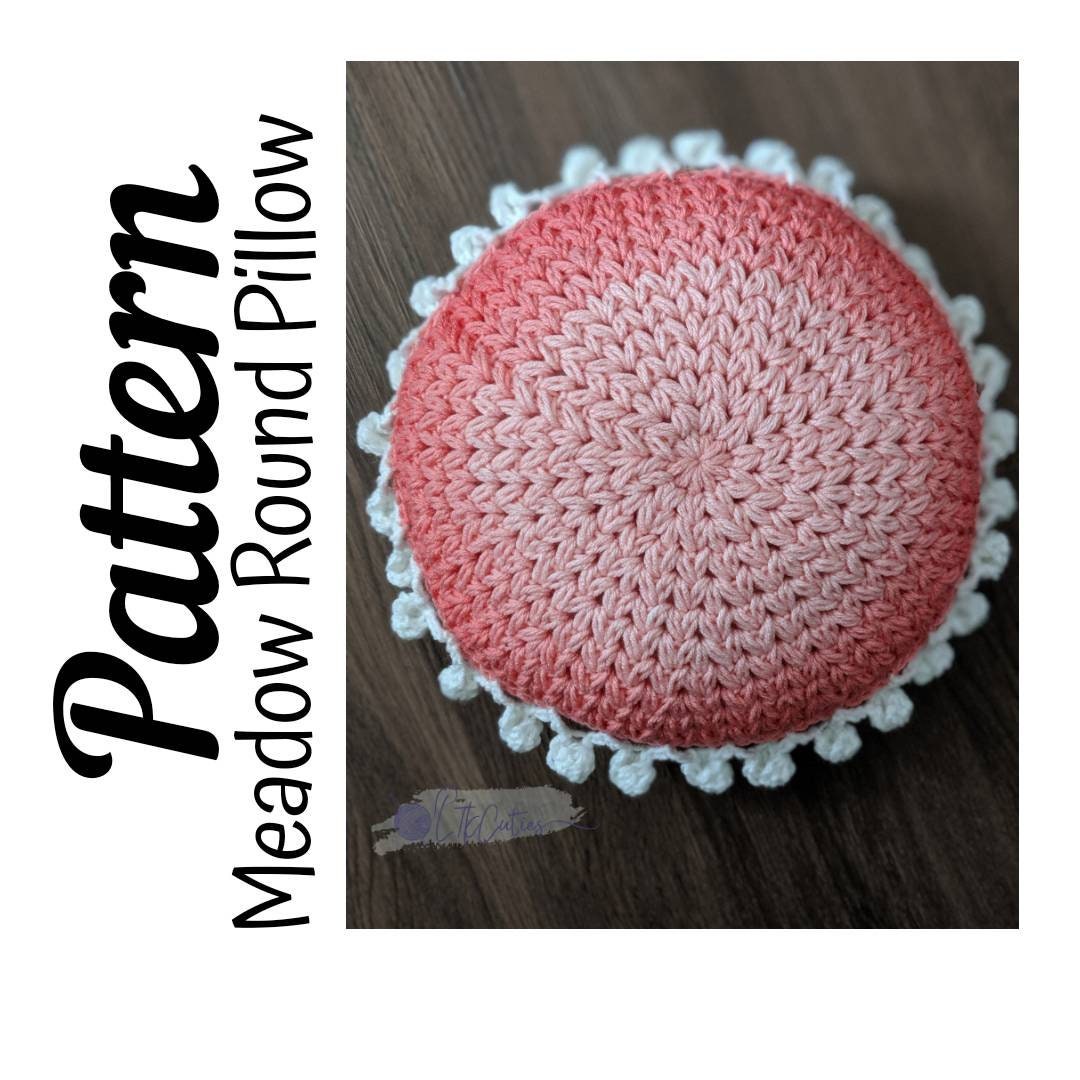 Meadow Round Pillow
The patterns beside each object are hand-crochet versions from the shop. They are here for two reasons: the finishing sections tell you how to do the parts your machine cannot — ribbed brims, real crowns, straps, closures — and sometimes you just want to make the thing by hand.
The beanie line
Fourteen hat patterns, graded from newborn to adult XL, all written in the same voice with the stitch counts spelled out. If you machine-knit the tube and want a proper crown or a ribbed brim on it, the crown and brim sections of these are what you work from.
See all beanie and hat patterns → Top Down Meadow Beanie
 Meadow Baby Hat
 Cypress Beanie
Machine knitting questions
What can I make on a circular knitting machine?
Anything that is a tube or a flat rectangle: hats, cowls, leg warmers, bags, pillow covers, cozies, scarves, blanket strips and sweater panels to seam by hand. What you cannot make is anything with shaping knitted in — no armholes, no raglan lines, no waist — because the machine has no way to increase or decrease.
How do I close the top of a machine-knit hat?
By hand, by gathering. Crank six to eight rows of waste yarn before you take the tube off, then run a long tail of your real yarn through every live stitch of the last real row, unpick the waste yarn, and draw the ring closed slowly, easing the gathers even as you go. Secure with two or three backstitches from the inside, then weave in. It takes about two minutes.
Are Sentro machines and punch-card knitting machines the same thing?
No, and it matters. A Sentro is a small circular machine with a fixed needle circle that knits plain tubes and has no punch cards at all. A punch-card machine is a flatbed — Brother, Silver Reed, Toyota, Singer — that reads a 24-stitch card to select needles, knits flat, and can be shaped. They share a name and almost nothing else.
Is a round loom the same as a circular knitting machine?
Same fabric, different speed and different flexibility. Both make a knitted tube at a fixed circumference set by the peg or needle count. The loom is slower and worked by hand, but you can choose how many pegs to work over on a long loom, do different stitches, and take stitches off to shape. A circular machine is far faster and does exactly one thing.
Are there free patterns for a Sentro knitting machine?
The tools on this page generate them. A machine-knit "pattern" is a row count, a colour sequence and a finishing plan — there is no stitch pattern to write down, because every stitch is the same. Put your machine, yarn and target size into the shaping calculator or the round loom hat calculator and print the result.
Why does my machine-knit tube curl at the edges?
Because it is stockinette, and stockinette always curls — every stitch is a knit on one face and a purl on the other, and the fabric rolls towards the knit side. The machine cannot make a non-curling edge, so you fix it in finishing: fold and hem, knit the piece double, or work a round of crochet or garter into the edge by hand.